
The following article written by Jenny Deters was written several years ago when there was an active llama wool pool in Indiana. The wool pool no longer exists, but these guidelines are still valuable to those preparing your own fiber to be sent to a mill.
About the Author
Jenny Deters has bred llamas at Deter’s Hickory Hollow Llamas in Evansville, IN since 1988. She has been active with fiber arts and spinning for several years, creating many handmade items from luxury fibers such as llama. She established and operated the Midwest Wool Pool from 1997 to 1999, holding fiber seminars and training others to carry on the wool pool’s fine tradition. She is also a certified ALSA fleece judge.
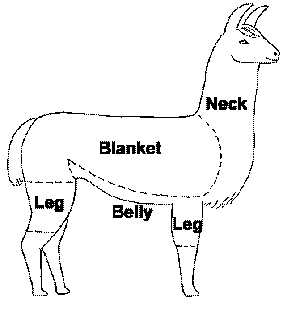
Llama Fleece Areas
I am not going to start exactly from the beginning on getting your fleeces ready for shipment to the wool pool, but I will say that the cleaner you keep your llamas through the winter, by good pasture management and feeding practices, the less work you will need to do in grooming your llamas before shearing. I will explain how we prepare our llamas at shearing time.
We use a chute, because we’ll also trim nails and do routine wormings at this time. Since most of our llamas have been sheared before, in one style or another, the blanket area is easy to groom, with a quick once over with the brush and then the blower to remove a majority of the dust. For those who haven’t been sheared, we’ll blow first, to hopefully remove some of the debris, then we’ll brush (two of us – one on each side) for a few minutes, then use the blower to get out the loose debris. If you simply can’t remove most of the debris this way, then the fleece may be too dirty to consider for the pool. (We do not expect perfectly clean fleeces, but the mill can’t process out all the debris and we do want yarns that can sell.) I’d like to add here, that we shear all our llamas, including the spring babies. Yep; even 2-3 months old.To shear, we use small electric clippers. We did use scissors for several years, but with a large number of llamas to shear, the electric clippers are faster. Some people use sheep shears – although we did have the large ones, we feel the chute to be too close quarters for the shears to be safe from cutting the llama, so we sold ours (we used to have angora goats.) Use whatever is comfortable.If on concrete, make sure the area is swept and clean. If on dirt, gravel, sand or whatever, put down a tarp or make sure the fleece doesn’t touch the ground. Keep the fleece clean. Sort out as you go by either shearing and removing the blanket area first (this is the best fiber) or shirt off the belly fiber as you go. The belly fiber is courser than the blanket – it is scratchy and definitely not sweater quality – don’t send this to the pool. As for the neck and leg portions, it depends on the llama as to the quality, so put this is a separate bag if you decide to send it, but remember it needs to be over 3″ long.
Fleeces that will not be accepted are: Fiber that is matted and can’t be easily pulled apart, fiber too short – the down, which are the finer hairs, needs to be at least 3″ long, fiber too long – do not send anything over 10″, preference is 6″, and fiber that contains rocks, pine cones, burrs, lice, moths or mold – don’t send.
Also for the ’99 shipment we ask that each of your fleeces be packaged separately. This can also be done by putting each fleece in its own plastic bag. (Please make sure the fleeces are dry before shipping or they will mold, therefore becoming worthless.) The length is very important, because if it is too long, say over 10″, the fiber will damage the mill’s equipment and if it is too short, the fiber will clump on the drums, keeping the yarns from being smooth and consistent.
We all want high quality yarns, but for the most part, it is the guard hair that keeps it from being the high quality. If you want to spend the time to get the high quality, you can pull out the guard hairs by hand (as of now, there aren’t any mills in the U.S. that can dehair our small amounts at a reasonable rate.) Our blends did improve the quality of the yarns, but the biggest drawback is the cost of these fine fibers. Eveyone seemed quite happy with the blends, so we will probably purchase them again in the ’99 pool.
What the future of our pool holds, we don’t know. Frankly, it is up to you. You could have items made with the fiber such as blankets, fabric, scarves, comforters, etc. But keep in mind, at this point we are only volunteers and we’d need to hire someone to handle the financial aspects of this type of endeavor. Our goal is to combine with the other pools in the U.S. to increase our poundage, someday tonage and we hope for an eventual Co-op, where our fiber can be sold. It all takes time, patience, and participation, but we’ve got to start somewhere. Be part of that start!